Tuesday, 16 May 2023

Scriever for the Federation of Writers (Scotland)

In early spring 2023, I was flabbergasted to be invited by the Federation of Writers (Scotland) to accept their role of Scriever for the year. Of course, I accepted this huge honour! It's a role designed to promote prose writing and complements the Makar, who is there to promote the writing of poetry. Previous Scrievers include Moira McPartlin, Leela Soma and Charlie Gracie.  FWS Chair Marcas Mac an Tuairneir presented me with a fine shield at the Love Words event in Perth. The very fine poet Morag Anderson was awarded the role of this year's Makar.

Chair of FWS, Marcas mac an Tuairneir, presents Carol McKay with the Scriever's shield, 25 February 2023

So far this year, I've run a creative writing workshop in Hamilton Town House Library and played a small part in Eadar-Theanga / Between Tongues  a zoom event celebrating Gaelic writing which was livestreamed on the FWS Facebook page. You can watch the recording via that link. I'm also running a mini-mentoring project in which I give feedback on a sample of individuals' writing. 

Most recently, I took part in a livestreamed discussion featuring a conversation between Morag Anderson, who is this year's Makar, Marcas mac an Tuairneir and myself. You can watch the livestream via this link Makar and Scriever In Conversation 14 May 2023 

The broadcast lasts just over an hour. To complement it, I thought I'd share the full answers I'd prepared in advance of the event. It's definitely worthwhile watching the livestream to see and hear the full discussion between all three of us. I learned so much from listening to Morag and Marcas's responses.

Anyway, here we go. It's quite a long post!

Carol's answers 

What attracted you to writing poetry / short stories etc?

A.     When I was wee, we didn’t have many books in the house, but we did have weekly comics and we got annuals for Christmas. Sometimes we visited the library, too. I used to craft my own books, folding up paper and sewing them in the seam. I’d draw, and create my own storylines, too, stimulated by whatever I was reading. As for poetry… although I’m not religious, I did love singing in school. Our regular songs were the old hymns from Victorian days, and the quality of language and love in those hooked me. That’s when I became aware of the power of thoughtfully placed vowel sounds and meter, e.g. ‘By cool Siloam’s shady rill/how sweet the lily grows. How sweet the breath beneath the hill / of Sharon’s dewy rose.’ (Reginald Heber, died 1826.) And what about ‘Oh little town of Bethlehem, how still we see thee lie. Above thy deep and dreamless sleep the silent stars go by…’  I mean, I’m probably an atheist now, but how could anyone fail to be wowed by those lyrics?

Also song lyrics from family party sing-songs. See my blogpost https://carolmckay.blogspot.com/2013/06/it-was-third-of-june-memory-nostalgia.html

I got into writing poetry because of those influences, at primary school. Lyrical prose writing came later, at secondary.

What are your favourite writers and poems / short stories / novels?

A.     I think he’s out of fashion now, but DH Lawrence was the prime influence for me. His Sons and Lovers was the first time I’d read and recognised myself in a novel. The main character was a boy and I was a girl, but that didn’t matter. He had a bond with his mother like an invisible umbilical cord, and so had I. He had a dad who was dangerous through drink, and so did I. And just so many other things about Lawrence. I loved his language, though I find it overly flowery now.

Favourite novels now include Jon McGregor. Anne Tyler. Claire Keegan. Graeme Macrae Burnet. 

Favourite poets are Don Paterson. Jim Carruth. Magi Gibson. Chris Powici. Finola Scott. So many! We live in privileged times.

Short story writers? Anne Donovan. Dilys Rose. Kevin Barry. Raymond Carver. James Kelman, of course, for making me realise that one dialect of English is a valid as any other and that to have – for example – urban Scots contained within speech marks while the narrator speaks ‘proper English’ is wrong, wrong, wrong. One person’s mother tongue is as valid as any other person’s mother tongue.

Which of your own poems (or short stories) are you most happy to have written, and why?

A.     I was overjoyed to have a short story make it into New Writing Scotland recently. It was a story that had been rejected 16 times but I believed in it and kept going, trimming it and reworking bits of it. It’s ‘Her Body Was An Aviary’, and it was in Break in Case of Silence: NWS 39.

I was also very pleased to have a story of mine feature as the opening story in the first issue of Gutter magazine. ‘Frozen Waste’ it’s called. I love and admire Gutter. I was pleased they opened their special 20th issue with one of my stories, too.

As for poetry – hmm – my usual themes in all my writing are about social misfits and alienation and addiction and so on, so probably ‘Holding all the ACEs’ is the one whose publication moves me most. It was in Gutter, too.   

I should mention that one of the things that quietly satisfies me most as a writer is actually something I self-published. Correction, my husband published it through his PotHole Press imprint. It was an ebook of personal accounts of what it feels like to live with the rare health condition Addison’s Disease. It was too niche for the general publishing world because only about three people in 10,000 have Addison’s Disease, but we saw the possibilities offered by ebook publishing, gathered 16 accounts from people around the English-speaking world through an appeal on social media, and brought them together in Second Chances: true stories of living with Addison’s Disease. It’s a life-threatening condition. I felt very alone when I was diagnosed in 2010 and I wanted to produce a book that people could turn to so they would be reassured they could live a good life even with the condition. My husband Keith made a great job of producing it.

Favourite ways to write? (e.g. special routines, places, comfort zones)

A.     Walking is good preparation! That and washing dishes. Mindless tasks with rhythm that enable the mind to wander free. I love being out in the natural world and often talk into my voice recorder on my phone to help me remember things as otherwise they’ve gone by the time I get home. I tend to be a daytime person, too, and I’m definitely more comfortable when there’s no one behind me and when there’s music playing quietly in the background.

Walking in nature boosts creativity


How many times do you edit a poem?

A.     As many times as I feel it needs! Some come more fully formed than others. I definitely recommend leaving a draft aside for a while before coming back to edit it. Editing is best when we can see a piece with fresh eyes. Reading out loud also helps us judge how it’s working.

How do you know when a piece of your writing is 'finished'?

A.     Is it ever finished? I had a short story in Glasgow dialect published this year in Five Glasgow Stories by Postbox Press, the literary fiction imprint of Red Squirrel Press. I edited that story so many times. Finally felt happy with it. Checked two stages of proofs before I finally okayed it. Got the book in my hand and realised I’d still managed to miss some things. Using ‘I’ instead of ‘Ah’. Wee things like that are always easy to miss and you just have to forgive yourself!

What advice would you give yourself starting out now?

A.     Network more. Don’t be shy. Get out there. But also read. Read what’s current. Go to events in your area. Don’t be the writer in the garret.

What magazines and websites do you recommend to writers?

A.     Well… Gutter! But also Extra Teeth, Southlight, Causeway, Poetry Scotland, Northwords Now, Soor Ploom Press. From Glasgow to Saturn. But also look beyond Scotland’s borders to Magma and Rialto, Honest Ulsterman and Stinging Fly and so on. Sign up to Creative Scotland and Scottish Book Trust’s mailing list to keep up to date with opportunities. The Federation of Writers itself has an amazing resource available to us through its monthly mail-out. St Mungo’s Mirrorball, too.

What makes a 'good' poem?

A.     One with vitality and freshness in language. But contemporary language. Not grandiose Victoriana.  Imagery – putting pictures in your head. And contemporary subject matter. It’s about experiencing the world we live in now. The human condition.

Is there a hierarchy in literature?

A.     Yes, there’s a hierarchy in everything, isn’t there. It’s just the way it is. Lots of wee burns flow into a river, and that flows into the sea. Each is a thriving community and each is important.

Are the gatekeepers of the publishing industry open minded, or does subjectivity - personal taste - play a part?

A.     I think we’re all creatures of our times and subjectivity is definitely a part of the selection process, be it for novels or for stories or poems. Fashions are just part of how it is. Publishers might want originality, but then reject it because it’s unfamiliar and they think it won’t sell. And they are running a commercial business, after all. But then someone else accepts that novel and it’s a hit and suddenly everyone wants more like that – it’s set a new fashion. I’m thinking here of someone like Graeme Armstrong, whose novel The Young Team took a long time to find someone to believe in it. (300 rejections?) And he’s now one of Granta’s young writers to look out for.

Should you 'write what you know'?

A.     Yes, but no, but yes, but…

What excites you about the future for poetry and other writing?

A.     In Scotland, at this time, we are seeing a lot of ‘New Scots’ in our schools. Far greater diversity than when I was growing up. I think that’ll work wonders for our creative sector. I’m really looking forward to that. They better get a move on, though, or I’ll not be around to see it!

What does the Federation mean to you, and – by extension – in what ways can the Federation help writers?

A. I think the Fed does wonders. A voluntary organisation with such committed board members and volunteers. It’s a great support network for writers at all experience levels, i.e. just starting out or old hands. FWS gives publishing, spoken word and networking opportunities aplenty. I love it!

Friday, 3 March 2023

Addison's Disease Self-Help Group / White Spirit

I'm sending huge thanks to the staff and volunteers at the Addison's Disease Self-Help Group charity. 

Not only have they given me a platform to promote White Spirit, but they've also done wonders in sharing the news about my novel through many outlets including their own website and newsletters, and social media. Thank you!

Thank you, too, to my early readers. I hope you enjoyed my novel - literary crime, set in the Scottish Highlands and featuring a police detective who is diagnosed with Addison's Disease mid-way through the story. Thank you to those of you who've left reviews and ratings!

Addison's is an auto-immune condition in which the body's own defences attack the outer layers of the adrenal glands. It's a slow and insidious condition, yet it can become horribly dangerous. Our adrenals tick along at only about 10% production until we need to fight off a bug, or break an arm, or face intense emotional stress. Then production surges. The trouble is, if your adrenals' outer layers have been largely destroyed by your own body, you just can't produce the increase in cortisol needed to cope with those stressors. 

And that's when you have an Addisonian Crisis. It's scary. And it can kill you. 

Read about it on the ADSHG website.

People diagnosed with Addison's take medication every day for life (literally), and carrying an emergency injection kit is definitely recommended. I last used mine two years ago when I ordered a gluten-free chocolate brownie in a cafe and thoroughly enjoyed it, only to realise three hours later when I was dying on the floor that it couldn't have been gluten-free after all. The emergency injection kit I'd got from the ADSHG, coupled with the medication from the health service, saved me.

Please do consider buying the ebook or paperback of White Spirit. If you do, you'll be helping support the ADSHG as I'm giving them my royalties.

To read my previous blog posts about my diagnosis and recovery, follow these links. (You'll be able to tell that I was (ahem) slightly overdosed on steroids in my earliest post about it!) You can also read about the ebook compilation Second Chances: true stories of living with Addison's Disease, which my partner Keith published for me through his imprint The PotHole Press in 2012.

First post - Growth Cycle

https://carolmckay.blogspot.com/2010/10/growth-cycle.html

Second post - The Real Story

https://carolmckay.blogspot.com/2010/10/real-story.html

Third post - Second Chances: true stories of living with Addison’s Disease

https://carolmckay.blogspot.com/2012/11/second-chances.html

Fourth post - Second Chances on the BBC

https://carolmckay.blogspot.com/2013/02/

Fifth post - Ten Years. Two Little Pills

https://carolmckay.blogspot.com/2020/10/


Friday, 2 December 2022

Now out - my crime novel White Spirit


Thirteen-year-old Jamie is found dead in the Scottish Highlands and DI Allan MacIntyre is asking questions. Who gave him his top of the range phone? Who lit the fire to dispose of his clothes? Two teenage boys are acting suspiciously. They have phones and games consoles hidden in their room, a connection to the mosque and a blood connection to a paedophile.

Then a second fire ‘ignites’ in a bin at their school. MacIntyre is beset with his own troubles, and it’s not just juggling two women. His health is letting him down, and, at 37, it shouldn’t be. With November fireworks exploding, one of the boys lets slip there’s going to be ‘a big one’.

Can Allan get a grip in time to prevent it?

White Spirit 

Set in the north of Scotland, close to Inverness, my new novel White Spirit combines a fast-paced plot with empathetic characters. Early reviews are in, and they're encouraging! 

'Totally absorbing' 

'Earthy gripping plot'

One of my aims for this book is to raise awareness about the life-threatening condition which is Addison's Disease - an auto-immune condition which often goes undiagnosed until it reaches the dramatic end-stage. I'm giving my author royalties from sales of White Spirit to the Addison's Disease Self-Help Group charity which has helped me so much since my own diagnosis.

You can read more about White Spirit and the rest of my writing on my website www.carolmckay.co.uk

You can read an extract on Amazon at https://www.amazon.co.uk/White-Spirit-Carol-McKay-ebook/dp/B0BJG61B5V

The e-book retails at £2.99 and the paperback is £10. 


Thursday, 6 October 2022

Reading the Landscape

I went to primary school in a vast council housing scheme in Glasgow. The school was called Stonedyke and there were forty pupils in each class. This was in the days near the end of the post-World War Two baby boom. School pupils were from the immediate neighbourhood and were from families where the mums tended to be housewives and the dads tended to work long hours in factories and industry. My dad was a slater's labourer and my mum bucked the trend and worked full-time in a shop.

It might seem like an unlikely place for poetry. And yet, this was an aspirational era, and an aspirational school, and this is where I was introduced to poetry. One of my favourites from when I was about ten years old is Aince Upon a Day by William Soutar,. It's written in Scots, and our class learned to recite it. Odd, when you think of it, since Scottish children were routinely discouraged from talking in Scots in school at that time. It was regarded as 'bad English', rather than being seen in its geographical and cultural context, i.e. as a separate strand with connections to Denmark and Germany and so on. 

Anyway, here we are, over fifty years later, and I've had my very own pamphlet of poetry published! Perhaps curiously, none of it is in Scots. But I'm sure the code-switching of my childhood helped arouse my curiosity about exploring language. Here it is:

Reading the Landscape

Reading the Landscape brings together poems previously published in literary magazines along with new work. It's published by Hedgehog Poetry Press as a result of their 'White Label - Quatre' poetry pamphlet competition.

The cover shows a scene from woodland in the Eildon Hills in the Scottish Borders. Landscape is key to my writing as landscapes and the natural world fill me with hope. The pamphlet contains poems that explore and relish the natural landscape as well as exploring inner mindscapes. You can read more about it (and be given the option to buy it) via that link.

It's a big moment for me, to have that first poetry pamphlet published after years of mostly writing prose. I'm now working on material for a second. In the meantime, having long been a fan and supporter of poetry publishing from Scottish poets and beyond, it gladdens my heart to see my pamphlet take its place with these other poetry books! 


Tuesday, 15 February 2022

Writing round-up

In my experience, writers suffer nightmarish levels of Imposter Syndrome. When I was a child growing up in Glasgow, in Scotland, this syndrome hadn't really been named, but was an overbearing presence in phrases like 'Who do you think you are? The Queen of Sheba?' and 'Don't get above yourself!' and even 'I kent his faither.' Working class children like me were conditioned from infancy to know their place and never aspire to anything beyond that.

A big part of being a writer is imagining other lives - lives beyond the narrow constraints we and/or wider society set ourselves. And if we want our writing to be published, we have to resist Imposter Syndrome.

With that in mind 😀I'm going to tell you that 2021 was quite a good year for my writing. Wait! No, 2021 was a good year. I didn't win prizes; I wasn't lauded around the world. But I did have a good handful of publications - individual stories and poems - in a range of quality magazines and anthologies, and that makes me feel my writing efforts are worthwhile.


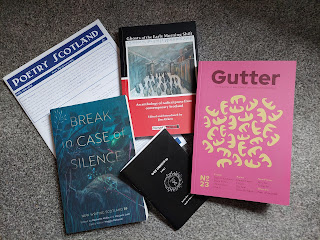
Poetry Scotland #102, Break in Case of Silence (NWS 39), Ghosts of the Night Shift, Wee Dreich #5, Gutter 23

While I'm pleased with all of these publications, I'm particularly happy that - after at least a dozen attempts - I've finally had a short story accepted for the very prestigious New Writing Scotland. Published by the Association for Scottish Literary Studies, this annual volume is the pinnacle for short fiction, poetry and other forms of writing.

Not only that, but the story itself - Her Body was an Aviary - is one that I'd sought a home for sixteen times before it was accepted. It's a story I've always believed in, but it obviously needed editorial distance to fully draw out its strengths. And, given there's always a subjective element to choosing items for publication, it must have needed to find the right editors, too!

Of course, I sent out far more than five items (well, six poems and two short stories). In the year, I sent out thirty-five submissions. So that's a hit rate of one in seven, or 14%. The year before that, my hit rate was about 10%. That's a lot of 'no thank you' to bolster the Imposter Syndrome, but according to Keysha Whitaker, who wrote about her study of this for US magazine The Writer in 2016, 5% acceptance is the average, with a range between 2% and 22.5%. So, hey, rejection is normal, and we should celebrate our successes without allowing ourselves to wilt under the stern gaze of Imposter Syndrome.

Incidentally, if you want to learn more about the origins of the term 'Imposter Syndrome', this link takes you to a paper written by Pauline Rose Clance & Suzanne Imes, the psychologists who coined it. 

Thursday, 8 July 2021

Linda Cracknell - The Other Side of Stone

I’m delighted to welcome to my blog this week author Linda Cracknell, a prize-winning writer of intense and beguiling prose. I’ve long been an admirer of Linda’s work and was eager to read her latest book.

The Other Side of Stone
pictured with Glen Lyon Tweed

The Other Side of Stone, published by Taproot Press, is a collection of linked stories centring on an old stone-built weaving mill in rural Perthshire.  Over the course of two centuries, the stories follow the creation and eventual decay of the building and the industry, and the impact this has on the people connected with it. Each story is self-contained, but together they build into a rich and coherent whole – layered like storeys in the building itself. This is an awesome achievement and a thoroughly satisfying experience for the reader.

In the opening story, Stone Curse, an old journeyman stone-mason inscribes the foundation stone for the radical new water-powered mill. His focus is on his work and the immediate surroundings of his workshop. It’s about the hard rock and the ‘fleabite’ of an indentation each strike of his chisel makes on it, putting into context our puny human concerns. The language is distilled and concentrated, deep with meaning. Indeed, even the word ‘strike’ becomes a recurrent motif in the collection. On the main face of the stone, he is carving the date – 1831. On the reverse, to be hidden away, he chips out an effigy of a woman. While the reader is drawn to the stone-mason – perhaps because of the affectionate way he describes a tiny visiting bird – this image he’s struck into the hard stone is his way of imprisoning the rule-breaking woman, and I would say this social mistrust of non-compliant womanhood and this need to restrict and restrain is central to The Other Side of Stone.

Look at Linda’s descriptive powers, right from the opening paragraph, describing that wee bird!

Some days it’s just the wee fellow who watches me. I see him through the hazel-arch of the workshop when I turn my head, and he’s there when I take my tools out to the forge to be licked sharp in the flames. He perches on the top of the rubble pile, or on a post, and observes. A smart-looker he is, with his white collar and chestnut stomach. Out of his dark face comes a scolding cry when there’s someone coming. He’s an unquiet bird then, with his ‘clack-clack-clack’, for all as if he’s bashing two stones together. … And the fellow’s my friend is he not? He’s my steady companion, watching me force the chisel upon the rock that’s so brute-hard my scours and drafts will be there to see for centuries to come.’

Linda takes us ranging back and forward over the years from 1831 to 2019, tuning in to the deepest concerns of workers and mill owners and others connected to the building throughout the phases of its origin, heyday and decline. What impresses me so much about Linda’s work – over and above the immense skills with language and observation – is that she rapidly establishes the feel of each era, with all its political considerations and pressures.

One storyline is returned to several times, weaving its way through the others. Set in 1913, it follows a young married woman who’s committed to achieving workers’ rights and women’s suffrage. She remembers May Day celebrations in Glasgow when her husband was a Union man and they were full of optimism, believing in unity and solidarity among the workers – until he accepted a promoted post in Perthshire. All like one big family, so we were … and Miss Sylvia Pankhurst herself up there, saying that the cooperative commonwealth will only happen if women as well as men manage it. (p.58) Catharine describes how alien she feels in this rural village, especially now he’s turned his back on their beliefs, in the words I’m like a flower grown from a seed that’s blown in from foreign parts’ (p.60) She has vision and ambition, and yearns to train as a nurse, but this is all in question. Will her husband sign the letter giving his permission?

Author Linda Cracknell  (Photo by Robin Dance)

Q&A

CMcK: Hello Linda, and welcome to my book blog! I have long been an admirer of your writing. Loved your short stories, of course, and your novel Call of the Undertow. Your creative non-fiction collection Doubling Back: Ten paths trodden in memory is another of my favourites. Before we get on to talk about The Other Side of Stone, let me ask – do you have a favourite form? How do you decide what form to write? What’s your process?

LC: Hi Carol, and many thanks for having me along. My process seems to be quite chaotic and hard to predict! The Other Side of Stone is my fifth book but there was no direct route or clarity as it developed. I usually start with character and place, and perhaps a ‘what if?’ train of thought or a particularly illuminated moment (which is likely to end up as a short story). I started writing short stories in the late 1980s after which I had two collections published. I love the economy and the elliptical nature of that form, but agree with Richard Ford when he calls it the 'high wire act of literature', because one tiny slip and the whole thing fails. The novel form is more forgiving.

As a new writer, there was quite a bit of pressure to produce a novel in order to be taken seriously, and it was setting out to write a novel in 2001 and then a few years later abandoning it that provided the foundation stones for this most recently published book. Although that first novel didn't ever quite work, when my explorations of an area around Dunnet Bay in Caithness offered up a story arising from an underlying folktale, it definitely had to be novel-length and Call of the Undertow (2013) was the result. Since then I've written another novel, currently looking for a publisher, set between the Scottish Highlands and the limestone sierras of south-eastern Spain in a story of mountains and suppressed memory. And I also write essays. Doubling Back: Ten paths trodden in memory (2014), was a linked collection of these, exploring place and memory through repeated footfall on paths. That also took its time to arrive at a final form.

In answer to your question I think the form probably asserts itself gradually as I write. Somehow, 20 years after setting out to write my first novel, I've ended up with this hybrid work of fiction which may be a novella or may be linked short stories, but definitely isn't a novel!

https://www.lindacracknell.com/mybooks-buyhere.asp

CMcK: So, The Other Side of Stone – it’s breathtakingly beautiful prose, deeply evocative of place and the tangible, physical world. Tell me how it came about, and something about your themes.

LC: The original novel I started writing in 2001 included two storylines which survived into 'Stone' but are now given very different weights. The major story is now a minor one and vice versa. In the act of abandoning the project I seem to have found the liberty to do as I pleased without the crippling self-consciousness which can come with anticipating publication. I returned over the years to the research and imaginative work I had done on the setting of the Perthshire woollen Mill. What was particularly compelling to me in what remained was the story of Catharine in 1913-14, a frustrated suffragette who arrives with her new husband, a weaver, in the small Perthshire village and finds herself increasingly isolated by her radicalism. The original novel also focused on the early years of this century when the building was being converted into flats by an ambitious young architect, and was somehow being dogged by the past. Around these two strands I gradually picked up other periods of the building’s history which interested me and wrote occasional new stories which used that background. I never imagined it would be published as one coherent work until last year I pasted them all into one document and added a final, more recent story which helped it all add up. It was a gamble that I could trust the reader to bridge the gaps not just within the stories themselves but between them. It seems to have paid off.

The strongest themes in my writing are usually place and memory, and that's certainly the case here with layers of history even within the stone itself. I like to think that the mill becomes a character itself through the different faces it shows in different periods. Beyond this, the overriding theme of the book has turned out to be the agency of women, and the struggle for this freedom as well as the potency of the local landscape and the effect of industrialisation on rural areas. I never set out to write to themes but let them emerge out of preoccupations with the setting and characters I've chosen.

https://taprootpressuk.co.uk/our-books/
Photo courtesy Robin Dance

CMcK: I really enjoyed that you’d tuned your ear to different styles of language for the different stories. So, in the 1913 episodes, you use quite a lot of Scots words and syntax – like a natural! And in the 2019 story, the teenager’s language is very much of our time. Was this a conscious decision or did it come about intuitively? Is it an essential part of creating characters?

LC: I'd say probably the latter, that the language must be an aspect of character. Catharine basically speaks monologues to the building itself, so it had to suggest the syntax of a Paisley cotton mill lass. Although it's not my own language, I did enjoy evoking it. And in 2019 Jade’s manner of speech, as a young carer who has failed in her formal education, needed to reflect her great weariness as well as background and the age in which she lives. It had to at least suggest authentic teenager.

CMcK: As well as being a versatile and accomplished published author, you’re an inspirational creative writing tutor. Where can we learn more about you and your writing, and buy copies of your books?

LC: I love teaching and encouraging others to write. The maxim I work by is Susan Sontag's: 'Love words, agonise over sentences, and pay attention to the world.' It works. I also like to get people outside and moving as part of the writing process. Over the period of the pandemic it has been quite difficult to continue with workshops, some of which are residential, but hopefully such things will gradually come back. I have found that as long as they're not too long, workshops on Zoom over a period of time can work very well and can defeat geography. I'm currently writer in residence for the Birnam Book Festival and will soon be running a course with them.

I have a regular newsletter in which such workshops as well as writing tips, various extras, and news of my own books can be found. Anyone can sign up through my website at this link: https://www.lindacracknell.com/feedback.asp

The Other Side of Stone (after a surprise sell-out of the hardback!) is now available as a paperback for £9.99 and can be ordered either directly from the Taproot Press website with no postage to pay https://taprootpressuk.co.uk/our-books/ , or ask your local independent bookshop to order it in for you. Call of the Undertow is available from my website as a special edition hardback and each of my other books is in print. As they've been with different publishers one of whom went into liquidation, they are available in slightly different ways. You can learn how here:  https://www.lindacracknell.com/mybooks-buyhere.asp

For anyone who’d like to hear more about The Other Side of Stone, here’s Birnam Book Festival’s event in which I discuss it with Jane Archer. https://www.facebook.com/watch/?v=190050849708686

Thank you, Carol, for inviting me to participate in your wonderful blog. And thanks to your readers who have got this far!

CMcK: My pleasure, Linda!

Author Linda Cracknell  (Photo by Robin Dance)


Thursday, 27 May 2021

Moira McPartlin - Before Now: memoir of a toerag


This week, I'm joined by the talented and versatile author, Moira McPartlin, whose new novel is published on 31 May 2021. It's super. Go on - treat yourself! Read on for a taster and to learn how Before Now came about.

Before Now: memoir of a toerag

Review 

The best kind of fiction is the kind you lose yourself in: the kind that sweeps aside your ongoing ordinary thoughts; the kind with a personality so absorbing you forget you’re supposed to take the dog a walk or wash the dishes. This is the kind Moira McPartlin writes. We’ve seen this in her novels The Incomers, and the Sun Song Trilogy, and here it is again in the glowing Before Now: memoir of a toerag.

A novel set in a Fife village in the 1990s, Before Now is a story told by teenager Gavin. He’s taken a risk that’s led to an accident, meaning he’s now immobilised in bed in his grandmother’s house for three months while he recovers. His mother has presented him with a notebook and told him to pass his time by writing about some of the high jinks and scrapes he’s had over the years.

Gavin is initially reluctant. A big, physically confident lad who’s been able to turn a van on a penny since the age of thirteen, he’s not at all into schooling, but she persuades him this could help him achieve his ambition of passing the theory part of the driving test. Just write, she says. Don’t worry about spelling and grammar. And, freed from the constraints of having to write in perfect English, Gavin finds his voice.

It’s a voice that liberates him – and unlocks, for a literary world, a teenage toerag’s dreams and reality. It does so through shrewd and skilful writing. The book is written in Fife dialect, but the author has taken pains to make this ‘non-standard’ English straightforward for non-Fifers to follow. In fact, after a paragraph or two, Gavin’s Fife accent became the soundtrack to my day. Like birds singing in the trees or the chuckling of the local burn, the rhythm and timbre of Gavin’s voice was an ear-worm I thoroughly enjoyed. Add to this some hilarious, vivid one-liners, e.g. Janey from The Valley ‘hud a clout like a miner’s shovel’.

Through Gavin’s stories, by turn laugh-out-loud funny and close to heart-breaking, we learn what it’s like to be a ‘daft laddie’ growing up in a small town devastated by the collapse of the coalmining industry. Whether he’s telling us about how they welcomed Tilly the dug into their lives, or the many times his long-suffering mother got called to the school about her two boys’ bad behaviour, or meeting many other characters, we get to know the real Gavin, who loves his mum and even his brother, and wants to move forward and live a good life. Moira's happy for me to post a couple of extracts. The first gives an idea of the trickier aspects to Gavin's life. The second is very different!

Moira McPartlin
 

Extract p. 41-2

The next day Chuddy an the gang ur wantin tae gan tae the chip shop near the swimmin baths, ah walk thum halfway doon the road then peel aff.

‘Ah’m away tae see ma da.’ Ah buys two cornbeef rolls fae the corner shop, wan fur him an wan fur me hopin he might buy sum juice cos ah’m now aw oot eh cash. Ah kent where he steyed coz ah hud swung roond there a couple eh times just tae check ah hud the right street. … Ah chapped. Thir wis nae answer. The door hud gless an a letter box. Ah peered through the gless but it wis too frostit tae see. Ah keeked through the letter box. The hoose reeked eh fags an soor milk.

‘Da, ur ye in?’ Nae answer. Ah wondered if he wis hidin, but the hoose felt empty, ah could tell. Ah shoved the cornbeef roll through the letter box an dragged ma erse back tae the skill.

Extract (p.81-2 )

So we dae. Efter huvin tae wait in a queue again fur ages we gets oan. ‘Just relax,’ ah telt her, but when we reached the board – fuck me – dis she no faa aff again. An this time ah keep gaun. Ah hear her shoutin.

‘No Gavin, it’s too misty.’

But ah ignored her. An then when ah get aff at the top, thick mist mobbed me an ah cannae remember where Tommy an Janey hud taken me that wis sae guid. So ah ski tae the top eh a run an it wis like ah sheer cliffside.

‘Whit’s this?’ ah asks sum bloke that wis starin doon at it an aw.

‘Black run. Don’t go down that son, unless you’re really good.’

So ah gan along a wee bit mair an thir wis this fence that hus ribbons oan it an a couple eh wee guys, wee-er than me, scoot past an doon. They disappear intae the mist. An it didnae scan too bad. So ah stertit doon an fuck me it got steeper. Ah gans cross weys an faa ower, ah gets masel up, turned an ski cross weys again but every time ah tried tae turn roond ah faa ower an thir wis guys scootin past aw the time, twistin this wey an that an straight doon. How dae they dae that? Ah just huv tae keep at it – cross, faa, turn. Cross, faa, turn an eventually the mist cleared an ah spied the café an Maw standin ootside watchin. Cross, faa, turn. It stertit tae flatten oot an ah hud a great run doon tae where Maw stood.

‘That wis great,’ says I. An in a wey it wis.

‘Oh Gavin. Ah’ve been worried sick. Ah got the staff tae radio the top tae look out for you but they couldn’t find you.’ She pointit at the slope ah’ve just come doon. ‘That’s a competition run.’

‘Aye? Think ah could dae competitions?’

‘Gavin, you were on yer bum most of the way.’

‘Best wey tae learn,’ ah chirps.

Efter that she niver took me unless Janey wis there but it wisnae that often coz skiin is dear.


Q&A

CMcK: Hello Moira and welcome to my book blog! Thank you for giving me advance sighting of Before Now. I adored it. My imagination bloomed with Gavin’s personality and his stories, told in a voice that completely captivates the reader. Why did you choose to write it in Fife dialect? And how difficult was that to maintain in this era of autocorrect?

MMcP: Thank you, Carol, for this fantastic review and these great questions. I love writing in dialect. It comes easily to me and I know, from the comments I received about my first novel The Incomers, that readers love to read it. I also perform early episodes of Before Now at open mic nights – the audience always enjoy them and I have great fun slipping back to the accent of my childhood.

Having said all that, the editing of a whole novel in Fife dialect was a nightmare. When I wrote the first draft I was not consistent with my choice of spelling and needed to revise it after the fact. This was difficult and time consuming. Many eyes have seen this novel and each time I look at it I still find tiny mistakes.

CMcK: There’s a gradual awakening in the novel, isn’t there, when Gavin is in that bed for three months and takes stock of his life. He says ‘Ma life’s been a bit chaotic up tae now. Sumthin hus tae change.’ (p. 75) Where did you get the idea of writing about this character, that location, and that time? And using what Gavin comes to see as that ‘catalyst’ of the accident?

MMcP: I have been working on Before Now for many years. It began as a couple of short stories. At that time I was reading reams of teenage fiction and I was bored with reading about middle class kids, whose teenage angst was very bland and their main worries were about their exams and being popular. My two boys were never academic and had a quite different life to the kids I was reading about, so I took a couple of incidents from their lives and fictionalised them. Once I created the characters of Sam and Gavin I found I could take it further because I know many children just like them. But I still had a series of shorts stories. I had to have some device to pull them all together and provide Gavin with a reason to tell his stories in the first place.  This was done by giving Gavin an accident and confining him in a space. I seem to do that a lot in my books. In Ways of the Doomed, book one of my Sun Song Trilogy, the main character is also confined.

I chose the 1990s because this is when my kids grew up and it seemed easier to do that because I can remember the toys and clothes they wore.

In terms of location, I am keen to show life in semi-rural Fife. Most novels I read in this genre have urban or West of Scotland locations. I feel Fife deserves its own stories. The location of Ashlee is a small village just along the road from Hollyburn, my village from The Incomers. Again, it was easier to fictionalise villages that are familiar to me in my own life. This is very much a novel of ‘write what you know.’

CMcK: With the book being written in first person, the characters are only seen through Gavin’s eyes, and through dialogue. It amused me no end to read Gavin’s opinions of his mother – that long-suffering, hard-working, dedicated, ambitious woman. He wasn’t pleased when her new job took her to Denmark for a couple of months when he was seventeen, meaning she wasn’t there to cook for him and do his washing! I loved the way you presented the understated grief, frustration and anxiety of the mother. She’d been through hard times! Many women writers might have sought to tell the story from the mother’s point of view. Why did you choose not to?

MMcP: When I first started writing Before Now I only wanted to write different teenage stories. I created the character of Gavin and his voice is so strong, and he is such a natural storyteller I had no choice but to let him tell the tales. When I showed the first couple of stories to my critique group they picked up on the fact that Maw’s story was also coming through. It was a bit of an ‘ah, ha’ moment. Suddenly the book became an adult novel and the tone changed. Once I realised that I could tell more than one story through Gavin’s point of view I worked hard to weave them in but keep it understated.

CMcK: Where can we buy your books and read more about you and your writing?

MMcP: You can buy Before Now, in paperback or Ebook from Amazon or you can buy signed copies from my website www.moiramcpartlin.com My website also has lots of information on all my other novels and some previously published short stories and poems.

CMcK: Thank you so much for joining me on my blog to talk about Before Now and your other writing! 

Before Now